
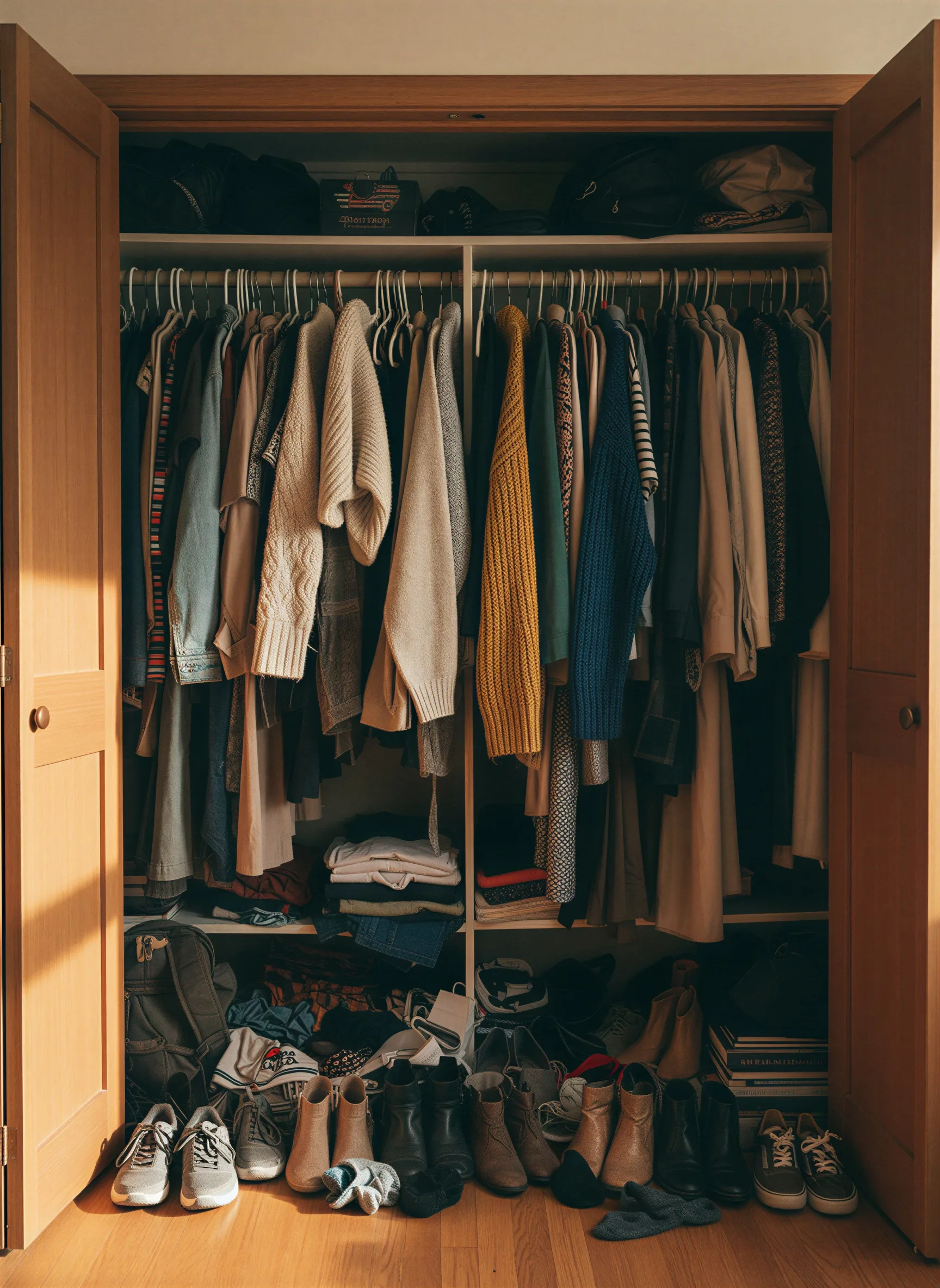
Why the organized closet is chaos again four weeks later
Saturday morning, everything piled on the bed, two hours of sorting. By the evening the closet looks like a catalog shoot. Four weeks later you are standing in front of it again, reaching for the same sweater for the fifth day running.
Storage is almost never the reason. Bins, shelf dividers, vacuum bags, velvet hangers: all of that fixes a space problem, just not the actual one. You've lost track of what you own. Whatever hangs behind the front row doesn't exist as far as your brain is concerned.
So how do you organize your wardrobe in a way that lasts? Five steps: empty it, declutter, sort, digitize, combine. The first three are manual work and cost you a free afternoon. The last two are what stop the whole thing from falling apart by the end of the month.
Step 1: Everything out, before you sort anything
Take it all out. Genuinely all of it, including the winter coat at the very back and the pile on the top shelf. Put it on the bed in one unsorted heap.
The point isn't the drama. As long as the pieces are hanging, you judge them in their usual context and skip half of them without noticing. On the bed you see the volume for the first time. And usually the fourth white shirt, the one you were sure was a second.
Wipe out the empty closet while you're at it. It won't be empty again for a while.
Before you start
- Block out three hours, not two
- Four large boxes or laundry bags, ready before you open the doors
- Something to drink and music, because this drags
- A charged phone, you'll need it from step 4 on
Step 2: Declutter your closet with four boxes
Now every single piece goes through your hands. No sorting by color yet, no exceptions, and above all no corner for "I'll decide that later". Four boxes, and every item lands in one of them.
The four boxes
- Keep: worn in the last twelve months, and you would buy it again today
- Out: doesn't fit, itches, has gone shapeless, or hasn't been touched in two years
- Repair: missing button, open hem, stain. Set a deadline: whatever is still lying there in four weeks moves to "Out"
- Unsure: tape the box shut, write the date on it, open it in six months
The unsure box is the part that actually works. It takes the finality out of the decision, and finality is exactly where most decluttering attempts fall apart. Whatever you haven't missed in half a year, you don't need. You don't have to believe that up front. You will simply see it.
One rule saves you a lot of arguing with yourself. If the first thing that comes to mind about a piece is how much it cost, that's not a reason to keep it. The money is spent either way. Whether the thing hangs in your closet or not changes nothing about that.
Step 3: Sort your closet, category beats color
Color gradients look glorious on Pinterest. As a working system they only half deliver, because at seven in the morning you're not looking for "something beige", you are looking for a pair of pants.
Two levels: category first, color inside it
So sort roughly by type of garment first, then arrange each group by color. That way you reach into the right zone and only have to scan what is in it.
- Hang: shirts, blouses, dresses, blazers, coats, anything that creases
- Fold: knitwear and heavy sweaters, because hangers stretch them out of shape
- Roll or stack: t-shirts and jeans, upright in the drawer instead of piled on top of each other
- Keep visible: accessories and belts, otherwise you forget they exist
Eye level belongs to everyday clothes
Whatever you wear weekly goes at eye level and within reach. Occasion pieces and the other season go right up top or right down at the bottom. Sounds obvious. It's also the difference between a closet that keeps itself in order and one that is a mess again in two weeks, because you have to shove three things aside every time to get at the one you want.
If you notice halfway through sorting that you seriously use about twenty pieces, that is the whole idea behind the capsule wardrobe.
Step 4: Digitize your wardrobe, one photo per piece
Up to this point most guides say roughly the same thing. The step nearly all of them leave out comes now.
Physical order works in exactly one place: standing in front of the open closet. Your clothing decisions, though, happen somewhere else entirely. In a store, when you're wondering whether that jacket goes with anything you own. On the train, when tomorrow's meeting occurs to you. Or at seven in the morning, half awake, with six minutes to spare.
That is why you photograph your things. One shot per piece, while everything is out on the bed anyway. The opportunity doesn't get better than this.
How to make it quick
- Plain background, daylight from the side, no flash
- One piece per photo, fully in frame, smoothed flat
- Work in batches: all the tops first, then all the pants
- Not all in one evening. One category a day is plenty
The boring part afterwards is what an app is for. In Try It every photo gets its background removed automatically, and the app works out category and color by itself. No form to fill in, no names to type. What you end up with is a digital wardrobe on your phone, sorted into the same categories as the real one.
And yes, that's effort. Once. After that each new piece costs you a single photo, ideally right after you buy it, before the tag comes off.
Step 5: Build outfits before you need them
Order isn't the point in itself. The point of the whole exercise is that you get dressed faster in the morning and end up happier with what you are wearing.
In Try It you swipe through your own pieces and put the combinations together yourself. Top, pants, shoes, jacket: you place side by side whatever you want to see. The app doesn't tell you what to wear. You see your own things next to each other for the first time and you decide.
The effect catches most people off guard. Pieces that hang three feet apart in the closet suddenly read as a look once they sit next to each other. The blouse with those pants, which never occurred to you because they live in different drawers.
Do it once on a Sunday evening for the week ahead. Four outfits, saved, done. Monday morning stops being a decision and turns into getting dressed.
How the closet stays organized
Organizing the closet is the easy part. The state it's in a month later is the hard one.
Four habits, and that is enough
- One new piece in, one old piece out. No exceptions, otherwise it isn't a rule
- Ten minutes on a Sunday: everything back where it belongs
- Photograph every new piece straight away, tag still on
- Two season swaps a year, and the decluttering falls out of it almost by itself
There's a side effect on top that hardly anyone expects. People who can see their own closet on a screen shop differently. You stand in a store, check quickly, and find out that you already own that grey t-shirt. Twice.
Common questions about organizing your wardrobe
How often should I declutter my closet?
Once a year properly is enough, as long as you stay consistent in between. The practical moment is the season swap you're doing anyway, in spring and in fall. Everything in between runs on one single rule: one new piece in, one old piece out.
Should I organize my closet by color or by category?
Category first, color inside the category. In the morning you're looking for pants, not for something beige. Pure color gradients do look better, but they force you to search the whole closet the moment you need one specific piece.
How long does it take to organize a wardrobe?
Plan half a day for emptying, decluttering and sorting. Photographing everything takes the longest, but it splits up well: one category per evening, and after about a week the whole closet is captured. Anyone who tries to power through it in one sitting tends to lose interest halfway.
What should I do with the clothes I get rid of?
Well-kept brand and designer pieces are worth listing on resale platforms. Everything else goes to local charities and shelters that actually accept clothing, and a quick call ahead saves both sides the trouble. Anything torn or worn through belongs in textile recycling rather than the bin.