
The suitcase is open on the bed, fourteen items are lying next to it, and for exactly four of them you could say where you would actually wear them. Two days later in the hotel it turns out that half of it never leaves the bag, while the one jacket that goes with everything stayed at home.
That is rarely because there isn't enough in the closet. It happens because packing collects single items instead of outfits. Planning travel outfits means doing the opposite: decide the combinations first, pack second. Here is how that works, from the first question to the moment the zipper closes.
Count the occasions, not the days
Seven days do not mean seven outfits. They might mean two travel days, three days at the beach, two dinners and one hike where nobody takes photos. That is four situations, not seven, and a couple of them repeat.
Before you open the closet, answer five questions:
- Duration: How many days are you away, and how many of those are pure transit?
- Weather: What range should you expect at the destination, morning and evening?
- Programme: Beach, hiking, meetings, dinners, museums?
- Dress codes: Is there an evening where sneakers would stand out awkwardly?
- Luggage: Carry-on only, or a checked bag?
Write the answers down. It sounds bureaucratic, takes two minutes and replaces every later "just in case". Because that feeling is exactly what fills a suitcase. You pack against an uncertainty you never resolved.
The number of outfits falls out of that list. Travel days wear the same thing there and back, beach days only need a cover-up over the swimwear, and two dinners are covered by one piece you can wear twice with different shoes.
The travel wardrobe: few pieces, many combinations
The trick is old and still works. Only bring things that go with each other. Sounds obvious, and in practice it fails because pieces get packed for being nice on their own, not for what they can do with the rest.
- A neutral base. Black, white, navy, beige, grey. These mix in any direction, so you are not standing in a hotel room at eight in the morning solving colour problems.
- One or two statement pieces. A strong blouse, a printed dress, a jacket people notice. That is enough not to look identical in every photo.
- The two-partner rule. Every item in the case has to work with at least two others. Whatever fails that test stays home. Yes, the favourite piece too.
- Decide the shoes first. They are heavy, bulky and the most common reason an outfit falls apart on the road. Two pairs. Three only with a good argument.
A little arithmetic helps with letting go. Three tops and two bottoms make six combinations. Add a jacket that works with all of them and you are at twelve. Six pieces, twelve looks, one week covered.
If your clothes generally refuse to get along, that is not a travel problem, it is a closet problem. The capsule wardrobe approach goes at the root of it: fewer pieces, all of which can work with each other.
Weather: plan for the range
Most people pack for the day they picture. Packing for the range makes more sense: coldest hour, warmest hour, plus rain. And a forecast only becomes reliable about a week before departure anyway. Everything before that is climate statistics, not weather.
Hot destinations
- Breathable fabrics: linen, cotton, thin viscose
- Light colours that don't show sweat
- Something to throw on for the air conditioning in restaurants, buses and museums
Cold destinations
- Layers instead of thicker single items: thin roll-neck, knitwear, coat
- One genuinely warm coat beats three medium jackets
- Scarf, hat and gloves add warmth without eating space
Unpredictable weather
- One waterproof layer that fits over everything else
- Quick-drying fabrics instead of heavy cotton
- At least one long-sleeve item, even in high summer
Outfits by occasion: beach, city, meetings
Now the situations from step one get their clothes. The order matters here: occasion first, outfit second. Do it the other way round and you end up with three dresses and no shoes you can walk eight hours in.
Beach holiday
- Two swimsuits, so one can dry while you wear the other
- A cover-up that also passes as a dress or shirt in the evening
- Sandals you can actually walk a kilometre in
City break
- Broken-in shoes. New sneakers on cobblestones are a bad idea
- A bag that sits across the shoulder and actually closes
- One layer to throw on that turns the day outfit into an evening outfit
Business travel
- Wrinkle-resistant fabrics, or you will be hunting for the hotel iron at night
- One colour line for everything, so trousers, jacket and shirt stay freely combinable
- One piece for dinner that looks off-duty and still matches the trousers
The hardest case is the mixed trip: two days of meetings, three days off. The bridge is the shoes and the colour line. The same dark trousers look serious in the morning with a shirt and leather shoes, and look like the end of the workday at night with a t-shirt and sneakers.
Give every day its outfit
At this point you have a pile of pieces that work together and a list of occasions. What is missing is the assignment. And that is what decides whether the plan holds up once you are there.
Analogue, it goes like this: lay the combinations out on the bed, photograph them, assign them to days, pack. It works, but it has two weaknesses. It needs floor space, and after the trip the photos disappear into the camera roll somewhere between a thousand others.
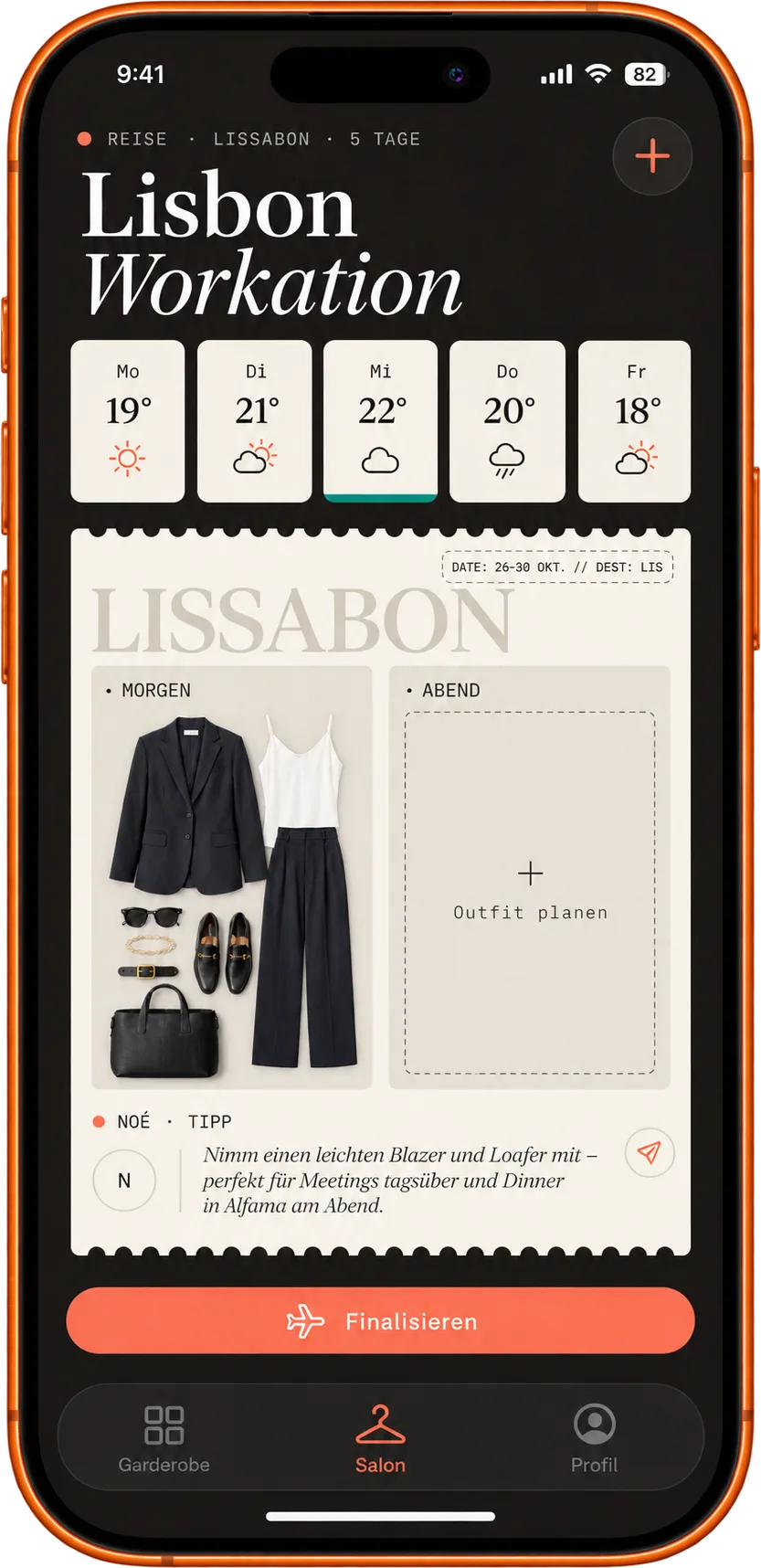
Digitally both problems go away. In Try It you photograph each piece once, it gets cut out from its background and tagged automatically, and your digital wardrobe grows as a side effect. Then comes the part people often get wrong. The app does not pick outfits for you. You swipe through your own tops, trousers and shoes and put the combinations together yourself. On the sofa, on the train, at eleven at night. You decide, not the app, only with the whole closet in view instead of the slice you can see through an open wardrobe door.
The travel planner hangs the trip on top of that. You create a destination with your travel dates, get the forecast for each day, add activities with their dress code and assign every day an outfit from your own closet. Out of that comes the packing list you tick off while packing. The travel planner is included with Try It Pro and Try It Atelier; what it does in detail is on its feature page.
The real gain is unspectacular. Before you leave, you can see which day still has no outfit. That is the gap that otherwise only shows up in the hotel.
The suitcase comes last
Only once the combinations are settled does anything go into the bag. Three habits are genuinely worth it:
- Pack by outfit. Pieces that belong together stay together instead of being sorted by category across the whole case. In the hotel you reach in once and you are dressed.
- Wear the bulkiest things. Heavy shoes and the thickest jacket go on your body, not into the luggage. Old trick, real space saved.
- Read it back once. Go through the occasion list and check that every entry has its outfit. Two minutes before you close the lid, not after.
How to combine folding, rolling and packing cubes so that a week fits into carry-on is a subject of its own. We wrote it up separately in Pack Like a Pro.
Common questions
How many outfits do I need for a week away?
Fewer than the number of days suggests. Don't count seven days, count the occasions: two travel days, three beach days, two dinners. Three tops, two bottoms and one jacket that goes with all of them add up to twelve combinations out of six pieces. Add underwear, swimwear and one pair of shoes you can walk long distances in, and you are done.
How do I plan outfits when the weather at my destination is uncertain?
Plan for the temperature range, not for the nicest forecast. A forecast only becomes reliable about a week before departure; before that it is a tendency. Until then the rule is simple: one waterproof layer, one long-sleeve item and clothes that can be worn on top of each other. That carries you through almost any change in the weather.
How do I pack for a business trip with free days attached?
Through the shoes and one shared colour line. Business trousers with a t-shirt and sneakers work in the evening, and the same trousers with a shirt and leather shoes work the next morning. Choose wrinkle-resistant fabrics so you can skip the search for an ironing board, and bring exactly one piece that can carry a formal evening.
Can I plan my travel outfits with an app?
Yes, though the app does not invent the combinations for you. In Try It you photograph your pieces, swipe through your own wardrobe and put the outfits together yourself. The travel planner attaches destination, dates, weather and activities to them and turns the result into a packing list you tick off while packing. The choices stay yours, the bookkeeping goes to the app.
The difference between a relaxed trip and an annoying one is usually settled the evening before. Not by how much ends up in the case, but by whether you know what you meant to wear on day four.